
As the world takes stock of its commitments to protect nature during the 17th Conference of the Parties to the Convention on Biological Diversity (CBD COP17) in Yerevan, Armenia, an important question confronts governments, environmental advocates, mining companies and communities alike: Can we continue to extract gold without undermining the ecosystems, public health and livelihoods on which sustainable development depends?
The answer must be yes, but only if we fundamentally rethink how gold is mined, how chemicals are managed, how mining waste is controlled and how environmental performance is measured.
Held under the theme “Taking Action for Nature,” CBD COP17 provides an important opportunity to strengthen global efforts to halt and reverse biodiversity loss. At the same time, the first International Conference of the Global Framework on Chemicals (GFC IC-1), scheduled for 16–20 November 2026 in Geneva, Switzerland, offers an opportunity to advance international cooperation on the sound management of chemicals and waste.
Although these two international processes operate under different mandates, they are closely connected by a common objective: protecting people and the environment from preventable harm.
For Uganda, the connection is particularly important. The country’s gold sector provides employment, income and economic opportunities for thousands of people, particularly in rural communities. Yet mining activities can also contribute to land degradation, chemical pollution, habitat destruction and risks to human health when they are undertaken without adequate environmental safeguards.
The challenge is not unique to Uganda. Across the world, gold mining illustrates the difficult balance between economic development and environmental protection. However, Uganda’s experience offers an important perspective on why global biodiversity commitments must translate into practical action at the local level.
The real challenge is not simply how to produce more gold. It is how to produce gold while protecting life, preserving biodiversity and securing the livelihoods of communities that depend on healthy ecosystems.
1. Why GFC IC-1 matters for the future of gold mining
Adopted in 2023, the Global Framework on Chemicals provides an international framework for the sound management of chemicals and waste throughout their life cycles, from production and use to emissions, disposal and the management of contaminated sites. Its five strategic objectives and 28 targets call for coordinated action by governments, industry, workers, scientists, civil society and other stakeholders.
For the gold mining sector, the framework is particularly relevant because mining involves the use and management of chemicals and generates waste that can threaten human health and ecosystems if improperly handled.
In artisanal and small-scale gold mining (ASGM), mercury is a major concern. It is used to separate gold from ore, but careless handling and the burning of mercury–gold amalgam can expose miners and surrounding communities to toxic mercury vapour. Mercury released into the environment can also contaminate soil and water, enter food chains and threaten aquatic organisms, wildlife and human health.
Uganda’s experience demonstrates the scale of this challenge. The National ASGM Status Report (Uganda), March 2025, published by IPEN, identifies artisanal and small-scale mining as the dominant source of the country’s gold production. The report cites earlier national baseline findings indicating substantial mercury use in gold processing. It also identifies gold-producing areas including Busia, Mubende, Kassanda, Buhweju and parts of Karamoja. Read the national ASGM status report.
These findings underline the importance of moving beyond policies and commitments towards practical measures that enable miners to adopt safer technologies and practices.
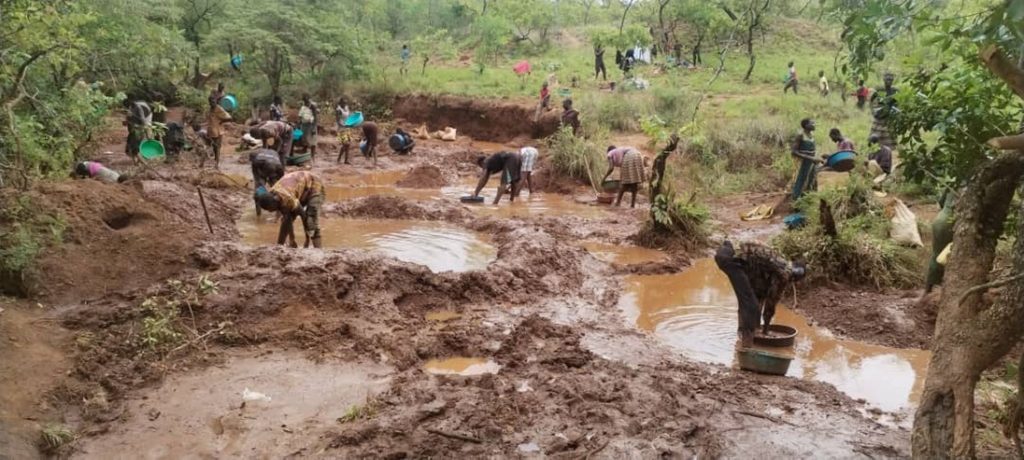
The problem extends beyond mercury. Mining can generate wastewater, tailings and waste rock containing potentially harmful substances. Where such waste is inadequately contained or treated, contaminants may enter rivers, wetlands, soils and groundwater. Abandoned pits and inadequately rehabilitated mining sites can also remain environmental and safety hazards long after extraction has stopped.
The Global Framework on Chemicals therefore offers an opportunity to promote a life-cycle approach to chemical safety: identifying hazards before they cause harm, preventing pollution at its source, strengthening regulation, encouraging safer alternatives and ensuring accountability throughout the mining value chain.
For Uganda, this means integrating chemical safety into every stage of gold mining, from exploration and extraction to processing, waste management, mine closure and environmental restoration.
It also means recognising that safer mining cannot be achieved through enforcement alone. Artisanal miners need practical training, access to affordable mercury-free technologies, appropriate financing, organised production systems and reliable markets for responsibly produced gold.
Government agencies, mining companies, mineral buyers, development partners and civil society organisations all have a role to play in supporting this transition.
GFC IC-1 provides an opportunity to strengthen international cooperation and ensure that the challenges faced by countries such as Uganda are reflected in the implementation of the Global Framework on Chemicals. The experiences of small-scale miners should inform global discussions on how to make chemical safety practical, affordable and enforceable.
2. The biodiversity–chemicals connection: Two global agendas, one environmental reality
Why should biodiversity policymakers care about chemical management? And why should chemicals and waste experts pay attention to biodiversity?
The answer is that pollution and biodiversity loss are closely interconnected. Chemicals released into the environment can move through water, soil, sediments, vegetation and food webs. Depending on the substance and environmental conditions, they may persist, accumulate or be transformed into other harmful compounds. Their effects can extend beyond the original mining site and affect ecosystems and communities farther away.
Mining can intensify biodiversity loss when chemical pollution occurs alongside deforestation, habitat destruction, soil disturbance, erosion and the fragmentation of natural ecosystems.
Consider what happens when vegetation is cleared to establish a mine, soil is excavated and gold is processed without adequate environmental safeguards.
Natural habitats are destroyed or fragmented, displacing wildlife and reducing the availability of food and shelter for many species. Excavation disturbs the soil, while erosion carries sediments into streams and rivers. Processing chemicals may enter the environment through spills, unsafe handling or inadequate waste treatment. Tailings and waste rock can continue releasing contaminants after mining activities have ceased.
These impacts are interconnected.
A polluted river can threaten fish populations, aquatic plants and freshwater organisms while compromising water resources used by households, livestock keepers and farmers. The removal of vegetation can increase erosion, alter water flows and weaken the ability of landscapes to withstand droughts and heavy rainfall. Degraded soils can undermine agricultural productivity, while the loss of natural habitats threatens the ecological processes that sustain food production, pollination and ecosystem resilience.
These concerns are especially important in Uganda, where rural communities depend heavily on agriculture, water resources, forests and other natural assets for their livelihoods.
The consequences are not distributed equally. Women, children, smallholder farmers and other vulnerable groups may face particular risks when pollution affects water sources, food security and household income. Women may carry an additional burden when families must travel farther to obtain safe water or cope with declining agricultural productivity.
This is why biodiversity conservation cannot succeed through habitat protection alone if chemical pollution continues to degrade the habitats being protected.
Equally, chemical management cannot be considered successful merely because a mining operation reports fewer spills or meets a workplace safety requirement. The wider consequences for water quality, wildlife, ecosystem functions and community livelihoods must also be considered.
A safer chemical process that continues to destroy critical habitat is not a complete sustainability solution. Equally, a biodiversity conservation programme that ignores toxic pollution cannot fully protect nature.
The two agendas must reinforce each other, and Uganda’s mining sector provides a compelling reason to pursue this integrated approach.
3. Uganda’s gold mining reality: Economic opportunity and environmental responsibility
Gold mining occupies an important place in Uganda’s rural economy. Artisanal and small-scale mining provides income and employment opportunities to people who may have limited access to formal jobs and other reliable sources of livelihood.
Mining activities occur in several parts of the country, including Busia and neighbouring districts in eastern Uganda, Mubende and Kassanda in central Uganda, Buhweju in western Uganda, and gold-producing areas of Karamoja.
For many households, the sector provides a source of income that supports food purchases, school fees, healthcare and other basic needs. It also generates economic activity for mineral traders, transport operators, food vendors and other small businesses.
Consequently, efforts to improve environmental performance must recognise the social and economic importance of the sector. An approach that simply condemns artisanal mining without offering viable alternatives risks overlooking the circumstances that drive people into the industry.
However, the economic benefits of gold mining must not obscure its environmental and public health risks.
In some mining areas, the expansion of excavation and processing activities has contributed to the removal of vegetation, the creation of open pits and the degradation of land. Where wastewater and mining residues are poorly managed, surrounding soils and water resources may also be placed at risk.
Mercury remains a major concern, despite existing efforts to reduce its use. Uganda has taken steps towards more responsible mining, including initiatives to support mercury reduction and safer technologies. The five-year planetGOLD Uganda project, launched in 2022 by the United Nations Environment Programme and its partners, was designed to support more responsible artisanal gold mining, improve access to mercury-free technologies and strengthen miners’ livelihoods.
Read about the planetGOLD Uganda initiative.
These initiatives demonstrate that a transition towards safer mining is possible, but sustained investment, enforcement, technical support and community participation remain essential.
The issue is also a matter of environmental governance. Uganda’s National Environment Management Authority (NEMA), the Directorate of Geological Survey and Mines, local governments and other responsible institutions have important roles in monitoring mining activities, enforcing environmental safeguards, promoting safer practices and ensuring that degraded sites are appropriately managed.
Uganda’s National Biodiversity Strategy and Action Plan III (2025–2030) provides a relevant national policy framework. Its emphasis on the sustainable use of biodiversity for inclusive wealth creation reinforces the need to integrate environmental protection into economic activities rather than treating conservation as separate from development.
Explore Uganda’s National Biodiversity Strategy and Action Plan.
The policy challenge is therefore clear: how can Uganda sustain the economic contribution of gold mining while reducing pollution, restoring degraded land, protecting biodiversity and ensuring that mining communities benefit from development without bearing disproportionate environmental costs?
4. Bringing global commitments home: What Uganda must do
Global frameworks can only deliver meaningful results when their commitments are translated into practical action at the national and community levels.
For Uganda, integrating biodiversity conservation with sound chemicals management requires a coordinated approach involving government, mining operators, local communities, civil society and development partners.
First, accelerate the transition towards mercury-free gold mining.
Uganda should strengthen efforts to reduce and eliminate mercury use in artisanal and small-scale gold mining, in line with its applicable legal obligations and international commitments. This requires more than prohibitions. Miners need access to affordable and effective alternatives, technical training, financing and processing facilities that allow them to recover gold safely and efficiently.
Second, strengthen environmental monitoring and enforcement.
Mining operations should be subject to appropriate environmental assessment, pollution prevention measures, safe waste management and effective monitoring. Government agencies should strengthen coordination, ensure compliance with applicable environmental and mining laws, and respond promptly to pollution incidents. Monitoring should cover not only mining sites but also nearby water sources, soils and affected ecosystems.
Third, make biodiversity protection part of the mining cycle.
Environmental protection should begin before mining starts. Sensitive habitats should be identified, avoidable damage prevented, and appropriate safeguards established. Mining operators should also plan for the rehabilitation of disturbed land, the safe closure of pits and the restoration of vegetation and ecological functions when operations end.
Fourth, put communities at the centre of decision-making.
Mining communities must have meaningful opportunities to participate in environmental assessments, monitoring and decisions affecting their land and livelihoods. Women and young people should be included in community education, consultation and alternative livelihood programmes. Local knowledge can help identify environmental changes and practical solutions, while accessible information enables communities to hold responsible institutions and operators accountable.
Fifth, support livelihoods alongside environmental reform.
Safer mining policies must recognise the economic realities of artisanal miners. Formalisation, access to responsible markets, affordable credit, improved working conditions and skills development can help miners adopt better practices without unnecessarily jeopardising their livelihoods. Alternative income opportunities should also be supported where mining is environmentally unsuitable or where operations must be reduced or discontinued.
Sixth, improve transparency and accountability across the gold supply chain.
Mineral buyers, traders and other actors should be encouraged and required, as appropriate under applicable law, to support responsible sourcing and avoid practices that contribute to environmental harm. Traceability, transparent reporting and clear responsibilities for waste management and site rehabilitation can help ensure that the benefits of gold production are not achieved at the expense of communities and ecosystems.
Finally, Uganda should strengthen collaboration between environmental authorities, mining institutions, researchers, civil society organisations and international partners. Such cooperation can improve access to technical expertise, support evidence-based policymaking and help mobilise resources for safer technologies, environmental restoration and community-based monitoring.
5. A shared responsibility for people and nature
The global biodiversity and chemicals agendas are not competing priorities. They are complementary approaches to protecting the natural systems that sustain human life and economic development.
For Uganda, safer and more sustainable gold mining should be understood not merely as a technical issue for the mining industry, but as a national development priority linked to public health, biodiversity conservation, water security, food security and community well-being.
The international community must recognise that countries cannot achieve meaningful biodiversity protection while pollution continues to undermine ecosystems. Equally, the sound management of chemicals and waste must extend beyond industrial compliance to include the protection of habitats, wildlife and the people who depend on them.
CBD COP17 and GFC IC-1 offer important opportunities to strengthen this shared vision. Uganda should use these global processes to advance practical cooperation, exchange lessons from its mining sector and strengthen the implementation of national environmental priorities.
The responsibility, however, does not end with international conferences or policy declarations. It must be reflected in the decisions made at mining sites, in the enforcement of environmental laws, in the technologies available to miners and in the participation of communities whose lives are directly affected by mining activities.
Ultimately, the measure of success will not be how much gold is extracted, but whether its production contributes to lasting prosperity without sacrificing human health, biodiversity and the ecological foundations of development.
Uganda and the wider international community must embrace a future in which gold mining supports livelihoods, responsible economic growth and environmental restoration—not pollution, degraded ecosystems and preventable harm