
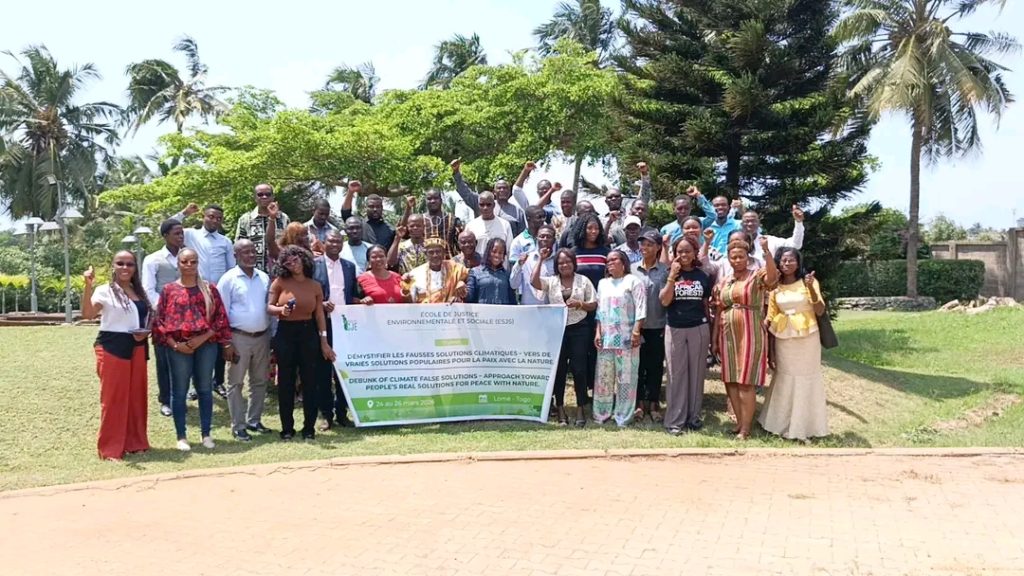
The Centre for Environmental Justice (CJE) –Togo convened the fourth edition of the School of Environmental and Social Justice from 24th to 26th March 2026in Lomé. This annual gathering brought together civil society organizations, grassroots movements, and community actors from across Africa. It provided a vibrant space for reflection, training, and mobilization around the continent’s most pressing climate, environmental, and social challenges.
The school’s central theme was the urgent need to expose and resist false solutions to the climate crisis—approaches that claim to address global warming but in reality deepen inequalities, displace communities, and entrench destructive economic models. Among these are geoengineering experiments, carbon markets, the financialisation of nature, and mega-dam projects promoted under the guise of clean energy.
Exposing False Climate Solutions
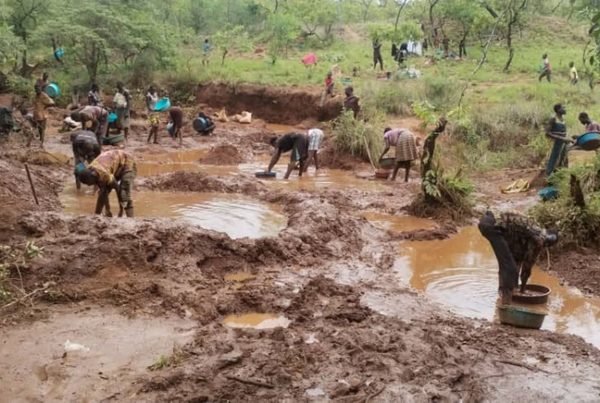
Participants critically examined the ways in which extractivism, fossil fuel dependence, and large-scale infrastructure projects continue to devastate African communities. While governments and corporations increasingly present schemes such as geoengineering or carbon offset markets as innovative climate responses, the school highlighted how these mechanisms perpetuate pollution and exploitation rather than solving the crisis.
- Geoengineering was described as a dangerous gamble with planetary systems, shifting risks onto vulnerable populations.
- Carbon markets and offsets were denounced as tools that commodify forests, soils, and oceans, enabling polluters to continue business as usual.
- The financialisation of ecosystems was shown to strip communities of sovereignty over their lands and resources, turning nature into tradable assets.
These approaches were framed as forms of eco-colonialism, imposed on African peoples in the name of development or energy transition, but ultimately serving external interests.
Consequences for Communities
The discussions underscored the human and ecological costs of these false solutions. Communities across Africa are already experiencing:
- Human rights violations linked to extractive industries, land grabs, and forced resettlement.
- Ocean and river pollution from industrial projects, undermining fisheries and food security.
- Ecosystem destruction and biodiversity loss, threatening cultural heritage and livelihoods.
- Erosion of livelihoods, particularly for women, youth, and indigenous peoples who depend on land and water resources.
These impacts reveal that climate policies driven by profit and exploitation cannot deliver justice or sustainability.
Resistance to Dams and Extractivism
The school reaffirmed solidarity with movements resisting mega-dams and destructive energy projects. While often justified as “green” or “developmental,” dams were exposed as false solutions that exacerbate displacement, ecological degradation, and climate vulnerability.
Participants shared testimonies from communities affected by dam construction, where promises of electricity and development gave way to loss of land, cultural sites, and food systems. The school positioned these struggles as part of a broader continental resistance against extractivism and imposed energy models.
Building Real Alternatives
Against this backdrop, the school emphasized the urgency of advancing true solutions rooted in justice, community power, and ecological sustainability. These include:
- Agroecology as a resilient and equitable food system that restores ecosystems and empowers farmers.
- Just transition frameworks that prioritize workers, women, and marginalized groups in the shift away from fossil fuels.
- Protection of the commons land, water, forests, and biodiversity against privatization and exploitation.
- Collective advocacy and solidarity strategies to strengthen ecological governance that respects people’s rights.
By centering environmental justice, these alternatives challenge the dominance of corporate-driven climate agendas and place communities at the heart of decision-making.
The School of Environmental and Social Justice in Lomé strengthened the capacities of activists defending communities and territories against destructive projects. It consolidated strategies for advocacy, solidarity, and collective action, contributing to a continental movement for climate justice.
In rejecting false solutions such as geoengineering, carbon markets, and mega-dams, participants affirmed that Africa’s path forward lies in people-centered alternatives solutions that protect ecosystems, uphold human rights, and deliver a just transition.
This gathering was not only a forum for learning but also a call to action: to resist eco-colonialism, to defend the commons, and to build a future where ecological governance is rooted in justice and dignity for all.