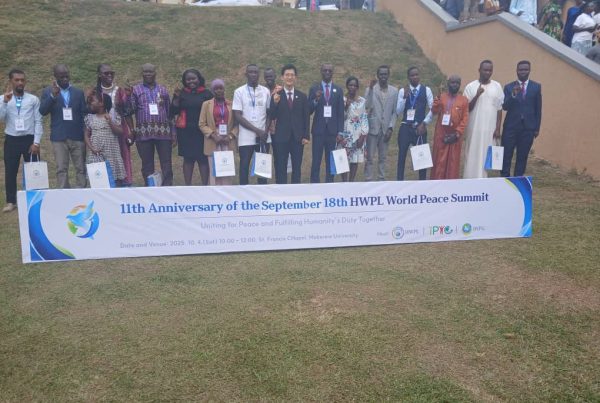

Bio Vision Africa (BiVA) and the Heavenly Culture, World Peace, Restoration of Light (HWPL) came together in a meeting that marked a turning point in grassroots action for peace and sustainability. Far beyond a courtesy visit, the engagement was a deliberate step toward forging a powerful alliance – one that unites BiVA’s proven expertise in environmental justice with HWPL’s global vision of peace and harmony.
Together, the two organizations are charting a path where peacebuilding and environmental stewardship are inseparable, and where community empowerment becomes the cornerstone of lasting change. By pooling their strengths, BiVA and HWPL are not only committing to joint strategies that restore ecosystems and livelihoods, but also to initiatives that rekindle hope, protect vulnerable populations, and secure the wellbeing of future generations.
BiVA highlighted its nearly six years of experience working with grassroots communities to address pressing environmental, climate, and social justice challenges. The Organisation noted that many communities continue to be presented with false solutions that fail to meet their needs, while instead deepening inequalities, displacing vulnerable populations, and reinforcing unsustainable development models. To counter these challenges, BiVA has implemented several community-based initiatives promoting sustainable chemicals and waste management. These include supporting artisanal and small-scale gold mining (ASGM) communities in Busia, Buhweju, and Kassanda districts to transition from the use of hazardous mercury to safer, mercury-free gold extraction technologies. BiVA also shared progress on its national campaign against mercury-added skin-lightening products, which primarily targets women and girls who are the largest consumers of these harmful products. The Organisation plans to expand the campaign nationwide through public awareness, advocacy, and capacity building for law enforcement agencies to strengthen enforcement of regulations governing the importation, distribution, and sale of mercury-added skin-lightening products. BiVA expressed its interest in collaborating with HWPL in implementing these initiatives.
HWPL, in turn, shared its ongoing efforts to promote environmental conservation, climate action, and peace through awareness campaigns conducted in Kampala and surrounding areas, often in partnership with members such as Bio Vision Africa. Globally, HWPL has advanced the concept of “peace with nature,” recognising that environmental degradation is both a driver of conflict and a barrier to sustainable peace. Its initiatives link ecological stewardship with peacebuilding, emphasising that communities cannot thrive in environments plagued by pollution, resource scarcity, or climate-induced displacement. In Uganda, HWPL’s awareness campaigns have underscored the importance of protecting ecosystems as a foundation for social harmony and intergenerational wellbeing.
This shared vision has already translated into tangible joint action. BiVA and HWPL have collaborated with the Buganda Kingdom in community clean-up campaigns, mobilising citizens to restore dignity and health in urban and peri-urban spaces. These clean-ups not only improved sanitation but also fostered a spirit of collective responsibility and peace among diverse community members. Similarly, during Buganda’s Environment Week, the two organisations jointly participated in a tree planting exercise in Gomba District. This initiative symbolised their commitment to environmental restoration and climate resilience, while also strengthening ties with cultural institutions that play a vital role in mobilizingI communities for sustainable development. HWPL also shared plans to launch initiatives aimed at supporting women and children in the Busoga region, with a particular focus on addressing the rising incidence of teenage pregnancies and the resulting increase in school dropout rates among adolescent girls. Recognizing BiVA’s extensive experience in community engagement and grassroots advocacy, HWPL proposed a partnership to jointly address these challenges through community education, advocacy, awareness creation, and empowerment programs aimed at protecting girls, supporting affected families, and promoting opportunities for adolescent girls to remain in school.
BiVA welcomed the proposal and noted that the Busoga region presents additional opportunities for collaboration. The organisation highlighted the previous widespread infestation of jiggers as an example of a neglected public health and social issue that has received limited follow-up from both government and civil society. BiVA observed that addressing such overlooked community challenges could generate meaningful and lasting impact alongside efforts to tackle teenage pregnancies. Both organisations agreed to continue discussions and explore opportunities for developing joint programmes that respond to the priority needs of communities while advancing peace, environmental protection, and sustainable development.
Resonance Between HWPL and BiVA
The synergy between HWPL’s peace and environment agenda and BiVA’s grassroots environmental justice work is striking. Both organisations recognise that peace is not merely the absence of conflict but the presence of justice, equity, and ecological balance. HWPL’s emphasis on linking peacebuilding with environmental stewardship resonates deeply with BiVA’s campaigns against mercury pollution, unsafe consumer products, and exploitative development models. Their joint clean-ups with the Buganda Kingdom and tree planting in Gomba exemplify how peace and environment can be advanced hand-in-hand, creating healthier and more cohesive communities. Together, they embody a holistic vision: communities free from violence, empowered to protect their environment, and supported to pursue sustainable livelihoods. For vulnerable communities, this partnership promises more than programmesit offers hope. By combining HWPL’s global peace frameworks with BiVA’s localised, evidence-based interventions, the collaboration can deliver transformative outcomes: healthier ecosystems, empowered women and youth, reduced inequalities, and stronger community resilience. In this way, peace and environment are not abstract ideals but practical tools for improving daily life and securing the wellbeing of future generations.